





Pack a moving box in layers: heavy at the bottom, a layer of paper in between, light on top, and fill every gap until nothing can move any more. Keep to 15 to 20 kilos per box, because the cardboard carries 40 kilos and your back does not. Lid closed, room written on top. Books upright in small boxes.
Below are the steps in order, the way our packers do them. Looking for a moving company in Haarlem? Do get in touch. On this page you will find what a move in Haarlem costs. More practical guides are in our English moving advice.
Choose the right moving boxes
Choosing the right boxes is the first step. You want boxes strong enough to carry your things and small enough to lift. So take boxes that are made for moving: identical boxes stack into a solid block, supermarket cartons do not. If you move with us, you get the moving boxes free on loan, with packing paper and labels, and we collect them again afterwards. Count on 16 to 20 boxes per person. Would you like to know how many m3 your household contents come to? Do get in touch.
Make a list of what you want to pack
Before you start, it helps to know what is coming with you. So make a list of your things: you keep an overview and you forget nothing. That same list helps you later when you unpack at the new address. More detail? Work through the list with our moving checklist, which sets out week by week what needs doing.
Sort your things
Sort your things before you start packing: group them by room, and within a room by size, weight or use. That makes packing quicker, because you do not lay heavy objects on top of light ones, and when you unpack you know straight away where a box belongs. There is no point being sparing with boxes: with us you get them free on loan, and nobody gets an overfull box up the stairs.
Use protective materials
To get everything there in one piece, you use protective material. Work mainly with unprinted packing paper, the way professional packers do: it grips, it fills and it does not scratch. Keep bubble wrap for screens, mirrors and genuinely delicate pieces, always with the bubbles facing the object. Do not use newspaper, because the ink comes off on porcelain and pale wood. How to pack fragile crockery is set out step by step in our packing tips.
Pack the moving boxes the right way
Build the box up in layers: heavy at the bottom, a layer of paper in between, light on top. Lay your things down neatly, push them firmly against each other and fill every gap with crumpled paper, until nothing moves when you give the box a shake. Tip everything in loose and the chance of breakage is a good deal higher.
Why good packing matters so much
Good packing protects your things not only on the road, but above all during loading and unloading: that is where things are lifted, turned and stacked. A box that is full and tight keeps its shape and carries the box above it; a half-empty box caves in and the stack starts to slide. It also keeps together what belongs together, so you are not left searching at the new address. That saves you time, money and a lot of stress.
How do you choose the right moving boxes?
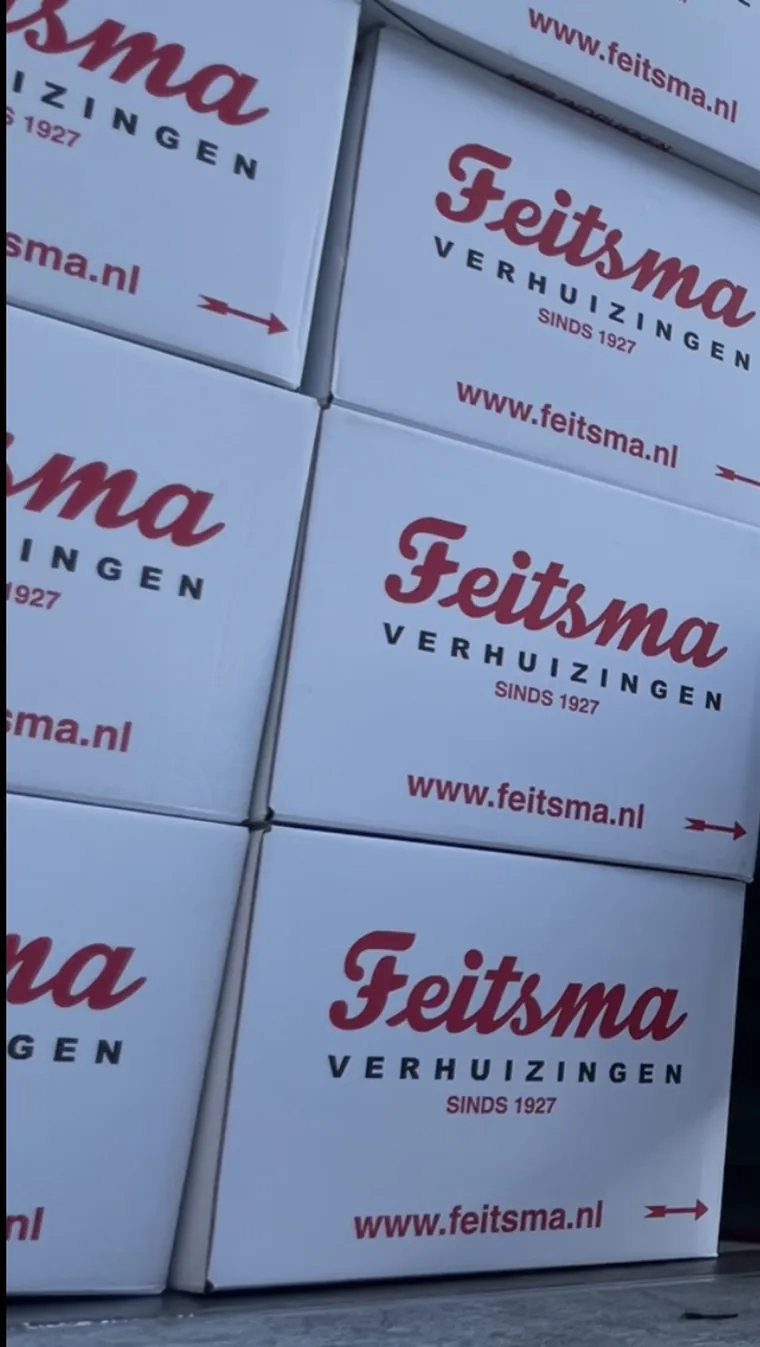
There are various kinds of moving boxes. One is made to be loaded heavily, the other is only meant for light things. This is what to look at when you choose.
- Size: choose the box to suit what goes in it. Small boxes for heavy and compact things such as books and tins, large boxes for light and bulky things such as duvets and pillows. The size limits the weight by itself.
- Strength: a good moving box carries 40 kilos and keeps its shape even at the bottom of a stack. Just do not fill it to that: your back is the limit, not the cardboard.
- Easy lifting: boxes with hand holes stay closer to your body, and that spares your back on every staircase.
- Stackability: identical boxes stack into a solid block, supermarket cartons do not. Cardboard is never waterproof, so in the rain you load from a dry hallway and the box does not stand outside.
How do you pack things into moving boxes?
Now that you know how to choose boxes, it comes down to the packing itself. Below are the steps in order; more moving tips are in our ten-point piece.
Get your materials ready first
Cut the paper and the wrap to size before you start, and set up one fixed spot with the paper, the tape, the scissors and the marker together. Put the box you are filling at table height instead of on the floor: packing at working height spares your back.
Use packing material
Fill the box not only with things but with paper as well. Crumpled packing paper keeps its shape and clamps the contents in place, while bubble wrap springs back and makes room to shift along the way after all. So keep bubble wrap for screens, mirrors and genuinely delicate pieces.
Spread the weight
Keep to 15 to 20 kilos per box. The cardboard carries 40 kilos, but the lifting limit of the Nederlandse Arbeidsinspectie, the Dutch labour inspectorate, is 23 kilos, and that applies only in ideal conditions, which a staircase never is. Spread the weight evenly across the base, so the box does not sag on one side. Books go upright in small boxes, not mixed in with clothing.
Bring in a professional
Packing moving boxes is a lot of work and it can weigh on you. Would you rather hand it over, then our packing service takes on the whole job. Our packing crew does an average household in a day. Request a quote.
Frequently asked questions
Which moving boxes do I need?
Count on 16 to 20 boxes per person and look at three things when you pick them:
- Strength
- Stackability
- Size
Buying them is usually not needed. If you move with us, you get the moving boxes free on loan: we drop them off and collect them again after the move. Our loan boxes have an autolock base and need no tape.
How do I pack without packing material?
If you have no packing paper or bubble wrap in the house, pack your fragile things together with soft textiles.
Wrap your crockery in towels and tea towels, and your glasses in T-shirts. That way your fragile things are protected without packing material as well. Just do not use newspaper: the ink comes off on porcelain.
Do I have to pack large items too?
Boxes are a good deal easier to move than loose items: they stack and they have hand holes. So put as much as you can into moving boxes. If something does not fit, there is no sense in forcing it into a box anyway; we carry that loose and protected with moving blankets.
Do you move seniors as well?
Yes, we handle senior moves too. Would you like tips on senior moves? You will find them on our blog.
Keys tomorrow, sorted today.
Send a few photos of your household contents on WhatsApp and you will know where you stand today.

Further reading.
How a professional mover packs.
What experienced crews do differently from most people at home, from building up a stack to protecting fragile crockery.
Read moreTen tips for a move without a hitch.
Ten points from practice that cut the chance of delay, damage or stress on the big day right down.
Read moreReady on the morning of your moving day.
The evening before and the first hour set the pace, so put out keys, parking space and a box of first essentials in advance.
Read moreUpdated on 13 August 2026.